
Dukes County Court Records After Arrest
After a Dukes County jail arrest, the custody file and the court file are separate records. The Dukes County Jail and House of Correction can address current custody, booking, and release questions. The court record is held by the Trial Court and can show the criminal complaint, docket number, court events, charge status, orders, and disposition. The prosecuting office for Dukes County is the Cape and Islands District Attorney's Office, which serves Barnstable, Dukes, and Nantucket Counties.
The local path usually starts with Edgartown District Court for criminal matters. The county court page says the District Court handles criminal cases, including felonies, misdemeanors, domestic violence, and town-ordinance matters. Dukes County Superior Court handles higher-level criminal matters and other superior-court work. For jail custody and booking details, use Dukes County jail inmate records; for booking photos, use Dukes County jail roster mugshots. The court record is the charge and case history, not the jail roster.
The Mass.gov court dockets and case information hub is the official starting point for online court lookup. Mass.gov says available information can include party, event, docket, and disposition details, depending on the department and case type. For most criminal cases, the docket number matters because Mass.gov states that most criminal cases are available online only by docket number.
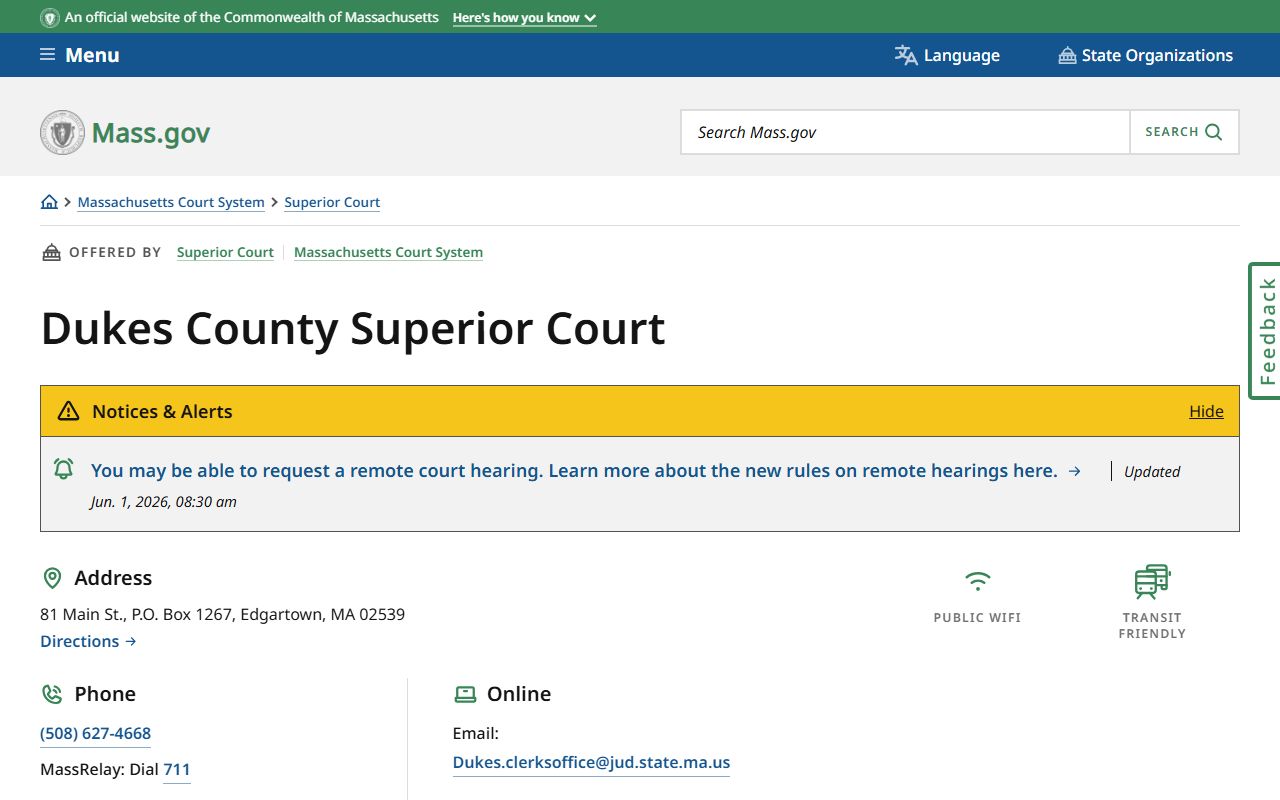
The Dukes County Superior Court Mass.gov page is a useful source when a case has moved beyond District Court or involves Superior Court jurisdiction. Its court listing helps separate court-held records from sheriff-held jail records.
That distinction is important because an arrest can produce more than one record stream: jail intake, police paperwork, prosecutor filings, and court docket entries.
Find Court Records After Arrest
Dukes County court records after arrest are most reliable when the search begins with the court that heard the arraignment or issued the docket. If no docket number is known, the jail may confirm whether the person is in custody, but the clerk is the better source for a filed criminal case. Edgartown District Court Clerk's Office is listed at 508-627-3751. Dukes County Superior Court Clerk's Office is listed at 508-627-4668. Older, sealed, impounded, or unavailable electronic records may require direct clerk contact.
- Confirm whether the person was booked locally through the Dukes County Jail and House of Correction control desk if current custody is the urgent issue.
- Ask the Edgartown District Court or Dukes County Superior Court clerk whether an arraignment, docket number, or public case record exists.
- Use MassCourts eAccess to search public case information when the docket number or other supported field is available.
- Open the case record and review the charge list, docket events, scheduled dates, orders, and disposition details shown for that case.
- Check whether any record is restricted by sealing, impoundment, juvenile limits, CORI rules, or another court-access rule before relying on an incomplete public view.
MassCourts is not the official paper court record, but it is the public electronic route identified by Massachusetts Trial Court guidance. The Mass.gov docket-search instructions identify Name, Case Type, Case Number, and Ticket or Citation Number tabs. For a Dukes County arrest that has just happened, the case may not appear until court processing creates a docket.
| MassCourts Field | Type | Use in Criminal Cases | Notes |
|---|---|---|---|
| Name | Search tab | Limited or case-type dependent | Official guidance identifies the tab, but public criminal name searching is not the main route. |
| Case Type | Search tab | Optional path | May be used with case type and date range searches. |
| Case Number | Search tab | Often required | Best route for most criminal cases because docket-number searching is key. |
| Ticket/Citation # | Search tab | Where applicable | Useful for matters that began with a ticket or citation. |
Dukes County Charging Documents
The court record after a jail arrest becomes meaningful when a charging document is filed. Booking terms may reflect arrest allegations, but the prosecutor's filing controls what the court case actually charges. In Dukes County, the Cape and Islands District Attorney may proceed by complaint in District Court or by indictment for more serious Superior Court matters. Massachusetts law also allows a summons rather than a warrant on complaint or indictment unless the court has reason to believe the defendant will not appear.
| Document | Who Starts It | Typical Use | Why It Matters |
|---|---|---|---|
| Complaint | Police or prosecutor through the court process | Common District Court criminal filing | Creates the docket and states the charges to be answered in court. |
| Information | Prosecutor | Prosecutor-filed formal charge where allowed | Reflects a charging decision after review of the arrest facts. |
| Indictment | Grand jury | Serious felony or Superior Court prosecution | Moves the case into a higher-level criminal track. |
The DA's Dukes County office is listed at 81 Main Street, P.O. Box 1115, Edgartown, MA 02539, with phone 508-627-7780. The official DA directory also lists Catherine Bumpus, Director of Policy and Programs, as the DA Records Access Officer. DA records are not a substitute for the court docket, but the office is part of the charge-filing path.
Dukes County Charge Status
Charge status can change after a Dukes County arrest. A person may be booked on one set of allegations, then charged in court with a different list after the prosecutor reviews reports, witness statements, police logs, and legal elements. A docket may show pending counts, amended charges, dismissed charges, disposition entries, or a nolle prosequi entry. Nolle prosequi means the prosecutor has chosen not to proceed on that charge.
| Status | What It Means | Where to Verify |
|---|---|---|
| Pending | The charge remains open and no final disposition appears in the public case record. | MassCourts and the clerk's office. |
| Amended or reduced | The original charge was changed, narrowed, or replaced by a different charge. | Docket entries and court orders. |
| Dismissed | The court ended that charge without a conviction on that count. | Disposition details and clerk confirmation. |
| Nolle prosequi | The prosecutor declined to continue prosecuting that charge. | Docket disposition and prosecutor filing. |
| Disposed | The case or count reached an outcome, such as plea, finding, dismissal, or other final entry. | Disposition details in court records. |
Do not treat a booking entry as a final charge status. A booking sheet may show why a person entered jail, while the court docket shows what the Commonwealth filed, amended, dismissed, or proved. That is the main difference between arrest information and court records after a jail arrest.
Bail After Dukes County Arrest
Massachusetts bail procedure is governed by M.G.L. c.276 s.58. The statute covers release on personal recognizance or bail, release conditions, review at the next court session when a person is not released, and a six-hour rule for certain domestic abuse or protective-order arrests. Dukes County official sheriff materials did not publish a bail-payment page, accepted payment methods, or an online bail vendor.
A separate dangerousness hearing may occur under M.G.L. c.276 s.58A when the Commonwealth seeks detention for listed offenses. A judge decides whether any release condition can reasonably assure public safety. If detention is ordered, timing limits differ for District Court and Superior Court, subject to good cause and excluded periods.
| Release Term | Plain Meaning |
|---|---|
| Personal recognizance | Release based on a promise to return to court and follow conditions, without cash bail. |
| Cash bail | Money set to secure the defendant's appearance in court. |
| Conditions of release | Court-ordered rules such as contact limits, supervision, or conduct restrictions. |
| Dangerousness hold | Pretrial detention after a judge finds no condition can reasonably assure safety. |
| Other hold | A separate warrant, detainer, or agency hold that may block release even after bail is addressed. |
Warrants After Court Records
No official Dukes County sheriff public warrant-search page, active warrant list, or statewide public warrant portal was located in the research. Massachusetts law at M.G.L. c.276 s.24 says a summons issues instead of a warrant on complaint or indictment unless the court or justice has reason to believe the defendant will not appear. Another statute, M.G.L. c.276 s.29, requires warrant-management-system checks before release in criminal matters.
For a possible active warrant in a Dukes County criminal case, the practical source is the court clerk, not an unofficial warrant aggregator. For a person arrested on a warrant and brought to the local lock-up or jail, call the jail control desk for current custody. For warrant-related booking records held by the sheriff, use the Records Access Officer process. MassCourts may show public docket events, but most criminal searches still rely on a docket number.
Dukes County Charge vs Conviction
A charge is not a conviction. That difference is central to reading Dukes County court records after arrest. A charge is an accusation filed in court. A conviction occurs only after a guilty plea, verdict, or other finding that creates a conviction record. Many cases include dismissed, amended, or reduced counts, and a public docket can show more than one status on different counts.
| Point of Comparison | Charge | Conviction |
|---|---|---|
| Stage | Accusation after arrest or prosecutor review. | Outcome after plea, verdict, or finding. |
| Proof | Based on filing standards such as probable cause. | Requires proof beyond a reasonable doubt or an admitted plea. |
| Record meaning | Shows what was alleged in the case. | Shows that a count was resolved as a conviction. |
| Use caution | May be dismissed, amended, or nolle prossed. | May still be eligible for sealing under Massachusetts law. |
Sealed and Expunged Records
Massachusetts sealing and expungement laws affect public access to court records after a jail arrest. Sealing restricts public access to an eligible criminal record. Expungement is more severe. M.G.L. c.276 s.100E defines expungement as permanent erasure or destruction. Related eligibility paths include s.100A for eligible convictions, s.100C for eligible non-convictions, and expungement provisions in ss.100I and 100K.
| Point of Comparison | Sealed | Expunged |
|---|---|---|
| Public visibility | Hidden from most public access after a lawful sealing order or qualifying process. | Erased or destroyed as defined by statute. |
| Record existence | The record still exists, but access is restricted. | The law treats the record as removed in a much stronger way. |
| Common use | Eligible convictions, dismissals, nolle prosequi entries, and other qualifying dispositions. | Time-based or non-time-based statutory grounds, if eligibility is met. |
| Public lookup impact | The case may not appear in ordinary public court search. | The case should not be available as a routine public record after expungement. |
Public Access Limits
Court records are governed by Trial Court public-access rules as well as statutes. Uniform Rules on Public Access to Court Records Rule 1 defines the scope of court-record access and recognizes that a judge may impound records. Rule 5 covers remote electronic access. The Addendum lists categories excluded from public access.
Important: A public court lookup is not a consumer report and should not be used for credit, employment, housing, insurance, or other FCRA-regulated decisions.
Massachusetts CORI law also matters. M.G.L. c.6 s.167 defines criminal offender record information, including information about charges, arrest, pretrial proceedings, incarceration, rehabilitation, and release. M.G.L. c.6 s.172 permits limited public written-request access to certain CORI categories, including some conviction and custody or placement information.
Juvenile matters, sealed charges, impounded filings, domestic-violence-protected information, ongoing investigatory material, and certain dismissed or nonpublic records may be withheld. If a Dukes County case search seems incomplete, that does not prove no arrest occurred or no case exists. It may mean the record is not available remotely, the docket number is needed, or an access rule applies.
Note: For court records after a jail arrest, verify charge status with the court clerk before treating a docket entry as final.